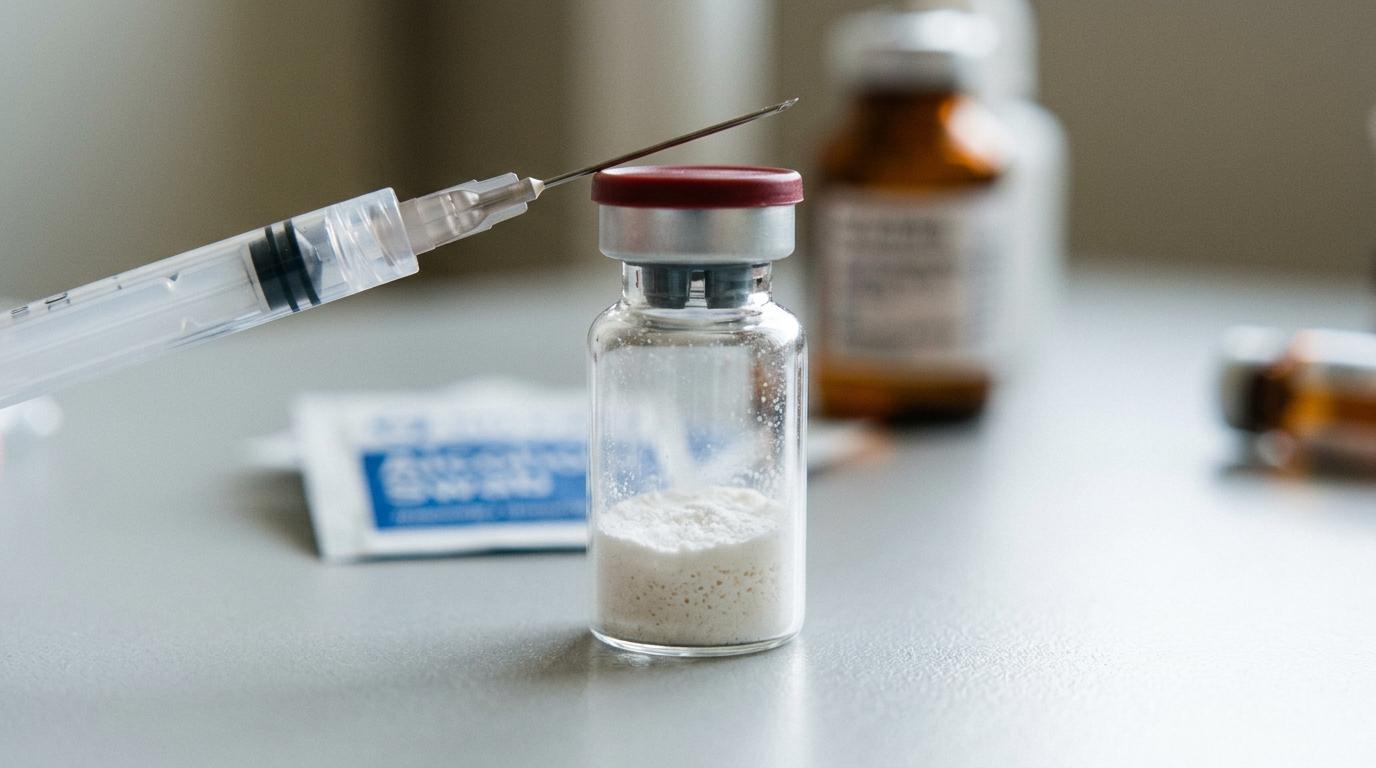
Peptide capsules sound simple, but peptide delivery is rarely simple. Most peptides are still better suited to injection because the gastrointestinal tract breaks them down and absorbs them poorly.
TL;DR: Summary
- For peptide capsules, the best fit is a peptide that can tolerate the oral route; for many other peptides, a lyophilized powder that is reconstituted before injection is still the more practical dosage form.
- RYBELSUS is the key FDA-approved benchmark for oral semaglutide in adults with type 2 diabetes, but its label shows how strict oral peptide dosing can be: empty stomach, no more than 4 ounces of plain water, and at least 30 minutes before food, beverages, or other oral drugs.
- Academic reviews report that many oral peptide approaches still have low and variable bioavailability around 1%, which limits which molecules can work well as capsules or tablets.
- MYALEPT illustrates the opposite use case: a peptide supplied as a lyophilized powder that must be reconstituted before use because an injectable presentation fits the molecule better than a routine oral product.
- If a peptide has poor GI stability, low intestinal permeability, short half-life, or tight exposure requirements, then an injectable powder is usually the safer formulation choice.
- Oral peptide success should be treated as a boundary case, not proof that the whole peptide capsule category is broadly solved.
That is why comparing peptide capsules with peptide powders is really a use-case decision, not just a format preference. The most useful question is whether the molecule, absorption profile, and patient workflow actually support an oral solid dosage form.
What are peptide capsules and peptide powders?
Peptide capsules and peptide powders solve different formulation problems. RYBELSUS shows that some peptides can reach market in an oral solid form, while MYALEPT shows the opposite case: a lyophilized powder reconstituted before injection.
In practice, "peptide capsules" is a broad shopper term. Commercial oral peptide products may be capsules or tablets, but the real issue is oral feasibility. A peptide taken by mouth has to survive stomach acid, digestive enzymes, and passage across the intestinal epithelium. That is a high bar.
Peptide powders usually refer to lyophilized drug product in a vial. The powder is stable in storage, then reconstituted with the specified diluent before injection. This format is common when the molecule is not a good candidate for oral exposure or when dose control matters more than swallowing convenience.
"RYBELSUS shows oral peptide delivery can work, but the FDA label still requires an empty stomach, no more than 4 ounces of plain water, and a 30-minute wait."
A common misconception is that a capsule automatically means a gentler or more advanced peptide product. It may simply mean the developer found one workable oral path for one molecule. That does not transfer cleanly to other peptides.
When do peptide capsules make sense for patients and manufacturers?
Peptide capsules make sense when oral semaglutide type conditions are present: some GI stability, acceptable variability, and a therapeutic profile that can tolerate limited absorption.
A 2020 review of oral peptide delivery described ideal oral candidates as peptides with a large therapeutic index, some gastrointestinal stability, a long elimination half-life, and relatively low clearance. If those features are absent, oral delivery gets much harder very quickly.
Patient preference matters, but biology still sets the limit. An oral dosage form can improve adherence and remove injection friction. Yet if exposure is too variable, convenience can come at the cost of inconsistent effect, harder regulatory review, or dose-escalation safety concerns.
A useful decision rule is simple. If the peptide needs highly reliable systemic exposure, then a reconstituted injectable may be the better operational choice. If the molecule can tolerate lower and more variable uptake, then an oral solid form is at least worth considering.
What are the 5 peptide capsule and powder use cases to know?
Five use cases cover most real decisions. RYBELSUS and MYALEPT are the clearest anchors because they sit on opposite sides of the oral-versus-injectable divide.
After those benchmarks, it helps to group products by how the molecule behaves rather than by marketing language.
- Approved oral metabolic therapy: RYBELSUS is the main proof point for oral semaglutide in adults with type 2 diabetes.
- Selective oral-candidate peptides: Molecules with some GI stability and longer half-life may justify capsule or tablet development.
- Reconstituted injectable peptides: MYALEPT-style lyophilized powder fits peptides that need reconstitution before use.
- Rapid-clearance peptides: Reviews note that many therapeutic peptides are still given as injectable sustained-release formulations because of short half-life and rapid plasma clearance.
- Technology-enabled oral reformulations: Some programs use permeation enhancers and solid dosage form optimization to adapt peptides originally designed for parenteral use.
The key trade-off is that each use case solves a different problem. Oral solids reduce injection burden, while powders often protect stability and dose precision. If a vendor treats those use cases as interchangeable, that is a signal to ask harder formulation questions.
How do you choose between oral peptide capsules and lyophilized peptide powder?
The best choice depends on molecule behavior, dose reliability, and patient workflow. FDA labels and PubMed reviews point to the same split: oral convenience versus injectable control.
A practical screen looks like this:
- Oral route fit: Choose capsules or tablets only if the peptide can survive GI conditions and still reach useful exposure.
- Exposure reliability: Choose injectable powder when low or variable bioavailability would create inconsistent clinical effect.
- Handling burden: Oral solids are easier for routine self-administration, while reconstituted powders add storage, mixing, and injection steps.
- Formulation logic: Permeation enhancers can help oral uptake, but they do not erase peptide instability or intestinal permeability limits.
- Regulatory maturity: An FDA-approved oral benchmark matters; a concept-stage oral peptide claim should be weighed more cautiously.
One pro tip here is to separate "oral" from "better." Oral is better only when it still delivers the intended exposure with acceptable variability. If the formulation needs heroic workarounds for basic absorption, powder may be the more honest format.
How should an oral peptide product be taken to protect absorption?
Oral peptide dosing must be precise. RYBELSUS is the clearest example because the FDA label ties absorption to a strict administration routine.
Before any steps, remember that oral peptide instructions are usually part of the formulation itself, not just a convenience note. Ignoring them can materially change exposure.
"RYBELSUS is the FDA-approved oral semaglutide for adults with type 2 diabetes, and its dosing instructions show how narrow oral peptide administration windows can be."
For RYBELSUS, the FDA label instructs patients to:
- Take it on an empty stomach.
- Use no more than 4 ounces of plain water.
- Wait at least 30 minutes before food, beverages, or other oral medications.
That timing is not arbitrary. Oral peptide products often depend on a narrow absorption window and formulation aids that work best under controlled stomach conditions. A frequent mistake is assuming "with water" means any amount, or that food timing is flexible. With peptide products, those details can be part of dose performance.
How is a lyophilized peptide powder reconstituted before injection?
Lyophilized peptide powder is built for reconstitution. MYALEPT shows the standard model: refrigerated storage, room-temperature equilibration, then mixing before use.
Reconstitution is not just a prep step. It is how the finished injectable is created from a stable dry presentation. That is why the specific diluent, mixing method, storage condition, and use window matter.
A typical label-driven workflow is:
- Warm as directed: MYALEPT labeling instructs users to remove the vial from refrigeration and allow it to warm to room temperature before reconstitution.
- Add the specified diluent: Follow the product instructions exactly rather than substituting a generic approach.
- Prepare for injection use: Once reconstituted, handle and administer according to the label or clinical protocol.
"MYALEPT is supplied as a lyophilized powder that must be reconstituted before use, which is often the better fit for peptides that are not practical as routine oral products."
A common error is to treat all peptide powders as interchangeable lab materials. They are not. Clinical products are presentation-specific, and reconstitution steps can affect usability, sterility, and delivered dose.
How do peptide capsules compare with peptide powders on bioavailability, convenience, and variability?
Peptide capsules win on convenience, while peptide powders often win on exposure control. Oral semaglutide and MYALEPT reflect that split.
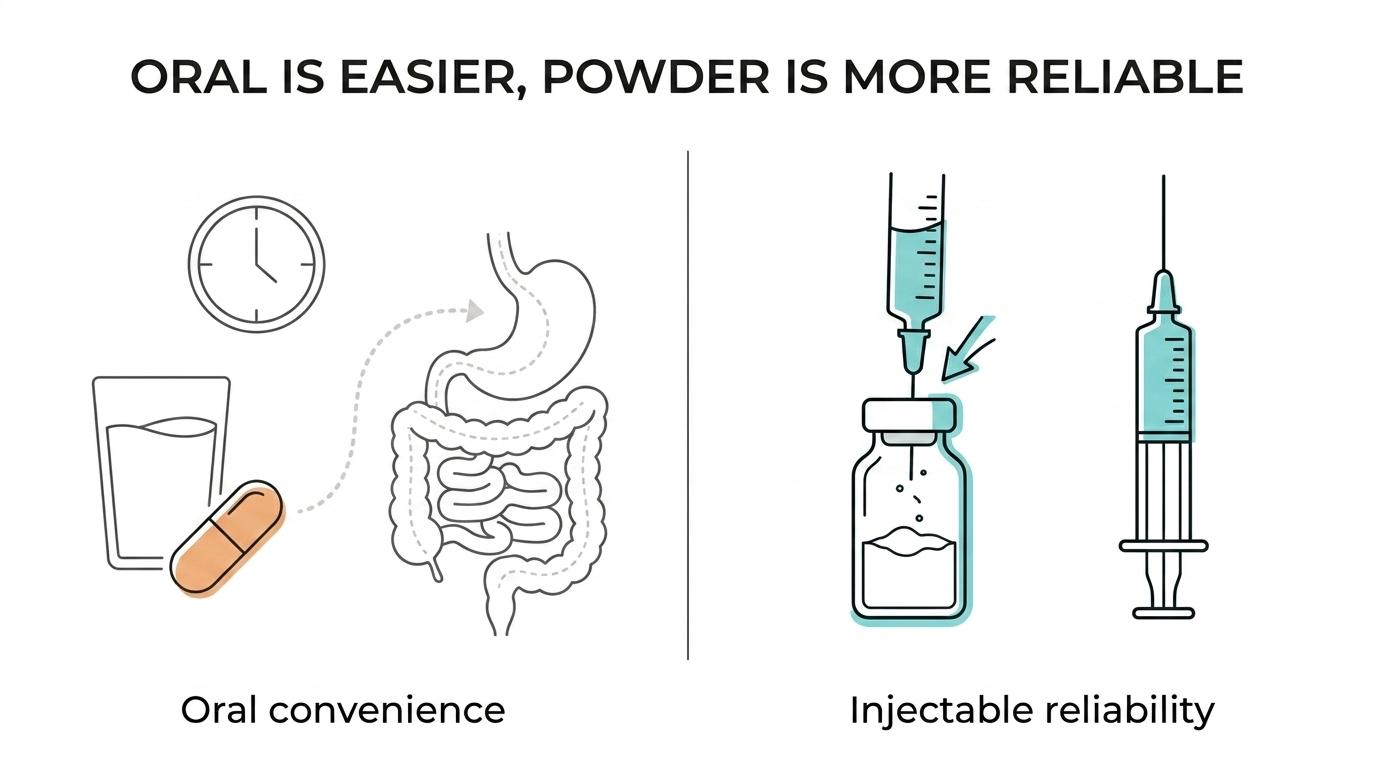
Academic reviews are clear that oral peptide absorption remains low and variable in many programs, with traditional permeation-enhancer strategies often landing around 1% bioavailability. That is also why Peptides Library, in its explanation of how cell-penetrating peptides work, treats delivery as a membrane-transport problem rather than something a capsule shell alone can fix. That does not make oral peptide products impossible. It does mean they tend to be molecule-specific rather than category-wide solutions.
Convenience strongly favors oral solids. Most patients would rather swallow a capsule or tablet than store, mix, and inject a drug. Yet convenience is only decisive if the product can still deliver dependable exposure. If it cannot, then the hidden cost is performance variability.
Powders have the opposite profile. They demand more handling and training, but they often fit peptides that need injection because of GI degradation, low permeability, short half-life, or rapid plasma clearance. If dose reliability is the first priority, powder often has the stronger case.
How can you vet peptide capsule claims before buying or prescribing?
The best way to vet peptide capsule claims is to check the dosage form, approval status, and administration rules. FDA labeling and PubMed reviews are the fastest filters.
This matters because peptide marketing language can blur oral feasibility with oral preference. A credible claim should show why the molecule works orally, not just why consumers like capsules.
Use this simple review process:
- Confirm the form: Is it actually an approved oral solid product, or is "capsule" being used loosely?
- Check the evidence: Look for FDA approval, label instructions, or published clinical data rather than broad absorption claims.
- Match the molecule to the route: If GI stability, permeability, or clearance look unfavorable, question whether oral delivery is truly practical.
One misconception to avoid is assuming a peptide powder is inferior because it is less convenient. In many cases, powder is the dosage form that respects the molecule’s limits instead of hiding them.
Why is oral peptide delivery still a boundary case rather than a solved category?
Oral peptide delivery is still a boundary case because PubMed reviews and RYBELSUS both show success is narrow, not universal.
Recent reviews argue that most oral peptide programs have not achieved regulatory or commercial success despite several generations of delivery technology. The recurring failure modes are exposure infeasibility, variability-driven regulatory problems, and toxicity that appears when developers try to compensate with dose escalation.
Permeation enhancers and solid dosage form optimization are useful tools. They can improve the odds, and they have helped create real products. Still, they do not remove the basic facts of peptide chemistry and intestinal transport.
That is the most grounded takeaway for anyone comparing peptide capsules and powders. If the oral route is truly workable, an oral solid product can be valuable. If it is not, a lyophilized injectable powder is not a compromise. It is often the correct formulation choice.