Peptide serum can be a smart buy if your goal is modest, cosmetic improvement in fine lines, hydration, and skin feel without the irritation profile many people get from stronger actives. The key is to compare formulations, labels, and claims rather than assuming every peptide product works the same.
TL;DR: Summary
- A peptide serum is best treated as a cosmetic support product for softer-looking wrinkles, better hydration, and improved skin barrier feel, not as a drug-like treatment for collagen loss.
- Clinical evidence is positive but mixed, and it is stronger for specific peptide formulations than for peptide serums as a broad category; several studies showed improvements over 56 days to 12 weeks.
- In the U.S., peptide serums are regulated as cosmetics, so labels should list ingredients by common or usual names, generally in descending order of predominance, and most do not need premarket FDA approval.
- Compare peptide serums by peptide type, support ingredients like glycerin or hyaluronic acid, irritation risk, packaging, and claim language rather than by marketing terms alone.
- If wrinkles are your top concern, retinoids still have the stronger evidence base; if tolerance and routine simplicity matter more, a peptide serum is often easier to use consistently.*
A good peptide serum purchase usually comes down to fit, not hype. If you know how to read the ingredient list, set a realistic timeline, and compare peptide products against retinol and hyaluronic acid, you can buy with much more confidence.
What does a peptide serum actually do for skin?
Yes. A peptide serum can help skin look smoother and feel better hydrated, especially when paired with humectants like hyaluronic acid or glycerin. Pal-KTTKS and acetyl hexapeptide are common examples, but the expected result is cosmetic improvement, not a structural rebuild of skin.
Peptides are short chains of amino acids used in skincare to support the appearance of aging or stressed skin. In practice, most well-formulated peptide serums aim to soften the look of fine lines, improve surface hydration, and support barrier comfort. That matters because dry, rough skin exaggerates wrinkles even when the wrinkle depth itself has not changed much.
A common misconception is that peptides “replace collagen” or work like injectables. They do not. Topical peptide products are limited by stability and skin permeability, especially at the stratum corneum, so the most credible claims are modest and appearance-based.
"The Ordinary Multi-Peptide + HA Serum is easiest to judge by its peptide blend, hydrating base, and ingredient order, not by peptide-heavy branding alone."
That does not make peptide serums weak. It means you should judge them by realistic endpoints: softer-looking expression lines, better bounce, more even texture, and less tightness after cleansing.
How strong is the clinical evidence for peptide serum?
Moderately strong for select formulas. PubMed studies and dermatologist-graded trials support wrinkle and hydration benefits from some peptide products, but the evidence applies to tested formulations, not to every peptide serum on a store shelf.
One useful study was a randomized, double-blind, placebo-controlled trial in 55 women ages 35 to 60 with mild to moderate facial fine lines and wrinkles. Participants used a peptide serum twice daily for 12 weeks, and dermatologist assessment found significant improvement in expression lines at 15 minutes and again at weeks 4, 8, and 12 versus placebo. Instrument-based tools including VISIA and PRIMOS CR also supported efficacy, and the serum was well tolerated.
Another often-cited data point comes from a 12-week split-face, double-blind, placebo-controlled study in 93 women ages 35 to 55. A moisturizer containing pal-KTTKS improved wrinkles and fine lines compared with placebo, which suggests some signal peptides can matter in topical use.
The trade-off is important. Evidence becomes weaker when people talk about “peptide serum” as a category instead of a tested product. If a brand cites peptide science broadly but does not explain its own formula, application schedule, or study duration, treat the claim set with caution.
What are the 6 peptide serums worth comparing today?
These six peptide serums are useful comparison points because they span budget, texture, peptide strategy, and supporting ingredients. None should be treated as universally best. They are simply strong examples of the kinds of peptide products shoppers often weigh against each other.
Before buying, compare each option against your own priorities: wrinkle-focused support, hydration, sensitivity, price, fragrance, and whether you want a minimalist serum or a multi-active formula.
- The Ordinary Multi-Peptide + HA Serum: A common benchmark for buyers who want multiple peptide names on label plus a hydrating base at a relatively accessible price.
- Paula’s Choice Pro-Collagen Multi-Peptide Booster: A layer-friendly booster format that appeals to people who want peptides without a thicker serum texture.
- Medik8 Liquid Peptides: A lightweight formula often considered by shoppers who already use vitamin A and want a gentler support serum in the same routine.
- Naturium Multi-Peptide Advanced Serum: A practical middle-ground option for buyers comparing cost, texture, and barrier-support ingredients.
- Peach & Lily Copper Peptide Pro Firming Serum: Worth comparing if you specifically want a copper peptide angle and a firming-focused product story.
- Biossance Squalane + Copper Peptide Rapid Plumping Serum: A good reference point for people who prefer a cushioned, emollient feel rather than a purely watery serum.
If two serums both list peptides, the deciding factor is often the base formula. A peptide serum in a well-tolerated, hydrating vehicle may outperform a more “advanced” formula that you stop using after a week.
How do you read a peptide serum ingredient list before you buy?
Start with the label. FDA rules require retail cosmetics sold in the U.S. to list ingredients by common or usual names, generally in descending order of predominance, which makes the ingredient panel your best first filter.
Step 1 is to identify the peptide names themselves. Look for terms like palmitoyl tripeptide, palmitoyl tetrapeptide, acetyl hexapeptide, copper tripeptide, or pal-KTTKS. Do not assume a peptide is useless if it appears lower on the list. Peptides are often used at low levels, so the support system matters just as much as rank order.
Step 2 is to inspect the formula around the peptide. Glycerin, hyaluronic acid, panthenol, ceramides, and soothing polymers can improve how the serum feels and how well you stick with it. A serum that dries tight or pills under sunscreen often loses in real life even if the ingredient story looks good on paper.
"Paula’s Choice Pro-Collagen Multi-Peptide Booster is the kind of product shoppers compare well when they focus on common ingredient names and the full support system, not peptide branding alone."
Step 3 is to evaluate the claim language. Cosmetics in the U.S. generally do not need premarket FDA approval, and companies are responsible for product safety under labeled use. That makes label literacy essential. If the box hints at changing skin structure or acting like a medical treatment, the marketing is moving past what peptide serum evidence usually supports.
How should you use peptide serum in a routine for best results?
Use it simply. Most peptide serums work best after cleansing and before moisturizer, once or twice daily, with sunscreen in the morning and enough time for consistent use over 8 to 12 weeks.
Apply peptide serum to clean skin, then follow with moisturizer to reduce water loss. If your product is very watery, use it before thicker essence or cream-serum layers. If your skin is sensitive, start once daily for two weeks. That approach tells you whether the serum itself is comfortable before other actives complicate the picture.
If you also use retinoids, exfoliating acids, or strong vitamin C, keep the routine easy at first. A useful pro tip is to separate high-sting products by time of day if your face starts feeling hot or reactive. More actives in one session does not equal faster results.
Another common mistake is underusing the product. One tiny dab every few days will not tell you much. A routine that is boring but repeatable usually beats a technically impressive routine you cannot maintain.
Peptide serum vs retinol: which is better for wrinkles?
Retinol is still the stronger wrinkle treatment. Peptide serum is usually the gentler option for people who want visible but modest improvement with less dryness, peeling, or routine disruption.
A 2025 randomized, double-blinded trial compared a 0.002% topical peptide serum with a 0.002% retinol serum and a vehicle serum over 56 days in healthy volunteers with aging skin. That is a useful direct-comparison model, but it does not erase the much deeper evidence base behind retinoids overall.
If wrinkle correction is your top priority and your skin tolerates retinoids, retinol or prescription retinoids still make the stronger first choice. If your skin barrier is reactive, you are trying to minimize irritation, or you want a serum that layers more easily, peptides often fit better.
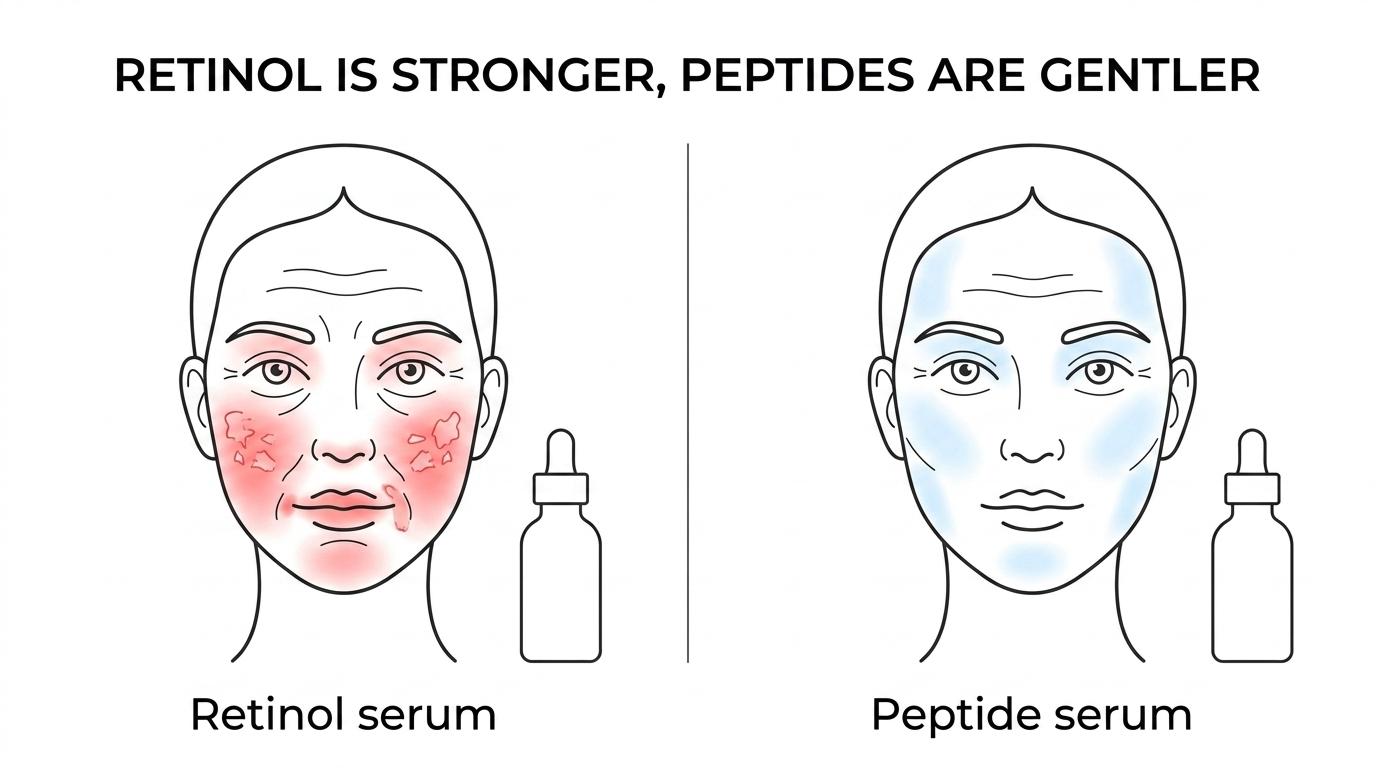
"Medik8 Liquid Peptides makes the most sense as a lower-irritation support serum, while retinoids still carry the stronger wrinkle track record."
The practical answer for many routines is both. Use retinoid as the main wrinkle active and use peptide serum to support hydration, comfort, and routine consistency.
Peptide serum vs hyaluronic acid serum: do you need both?
They do different jobs. Hyaluronic acid serum gives faster plumping and water-binding support, while peptide serum targets slower cosmetic changes in line appearance, skin feel, and surface quality.
If your skin feels dehydrated by noon, hyaluronic acid often gives the more immediate payoff. If your main concern is the look of fine lines and early aging, peptide serum is the more targeted buy. Many products combine both, which is one reason some peptide serums feel good within minutes even though peptide-driven visible changes take longer.
There is also a budget angle. If you already use a rich moisturizer with humectants, a separate hyaluronic acid serum may add less value than a peptide serum. If your routine is bare-bones and your skin is chronically dry, a simple HA serum might solve the bigger problem first.
A 12-week regimen studied in women with mild to moderate photodamage combined a hyaluronic-acid-based serum with a peptide-rich cream and found improvement in skin appearance and overall quality. That does not prove everyone needs both, but it shows why the pair is common in anti-aging routines.
How can you tell if a peptide serum is marketing-heavy or evidence-aware?
Look for modest, measurable claims. Evidence-aware peptide products talk about fine lines, hydration, texture, tolerance, and time frames like 8 or 12 weeks, not instant collagen rebuilding or injection-like effects.
The most reliable product language tends to mention how the product was tested. Credible details include dermatologist grading, controlled study design, before-and-after imaging, or instruments like VISIA and PRIMOS CR. Vague phrases like “neuropeptide complex” or “bio-signal technology” can be useful clues, but they are not proof.
Another red flag is overpromising. Regulatory language matters here as well, and Harmony Skin Lab’s overview of skincare manufacturing standards shows how compliance-focused brands tend to keep claims anchored to product category and substantiation rather than treatment-style promises.
FDA notes that products making structure-or-function claims for the body, including the skin, can cross into drug territory. If a serum claims to alter skin structure in a treatment sense, the marketing deserves extra scrutiny.
A pro tip here is simple: compare the claim to the likely cosmetic endpoint. If the label says smoother-looking expression lines and better hydration, that is believable. If it says muscle-freezing or collagen replacement, the language is ahead of the evidence.
What mistakes make peptide serums underperform?
Most failures come from expectations or routine design, not from peptides alone. The biggest mistakes are quitting too early, buying based on hype words, and using the serum in a routine that keeps the skin barrier inflamed.
Peptide studies that showed benefit often ran for 56 days to 12 weeks, with twice-daily or consistent scheduled use. If you stop after ten days because you do not see lifting, you have not really tested the product. Peptides are not quick-fix actives in the way a humectant can be.
Another mistake is treating price as a proxy for delivery. A luxury serum may feel excellent, but higher cost does not guarantee better skin permeability or more useful peptide biology. Packaging can help with stability and user experience, especially airless pumps or opaque bottles, yet it is still only one part of the formula story.
A common misconception is that peptide serums can compensate for poor basics. They cannot. If your cleanser is overstripping, your moisturizer is too light, and sunscreen is inconsistent, the serum is working uphill every day.
How long should a peptide serum take to show results?
Expect two timelines. Hydration effects can show up the same day, while visible changes in fine lines, texture, and skin quality usually need 4 to 12 weeks of steady use.
Start with baseline photos in the same lighting and at the same angle. That single habit removes a lot of guesswork. In the first two weeks, judge comfort, hydration, and whether the serum layers well under sunscreen or makeup. At that stage, most visible improvement comes from the vehicle, not from longer-term peptide action.
At weeks 4 through 8, look for softer expression lines, less creasing from dryness, and a smoother overall skin surface. By week 12, you should have enough evidence to decide whether the product earns a permanent spot in your routine.
If you see zero change and the serum is otherwise pleasant, the issue may be target mismatch. A dehydrated skin problem often responds faster to humectants and barrier repair. A deeper wrinkle problem may still need retinoids, procedures, or both.