Search interest in muscle growth peptides is high, but the category is often misunderstood. Many compounds discussed in forums and sold by research suppliers like Peptriva are growth hormone secretagogues or GHRH analogs, not direct anabolic steroids. That difference changes the evidence, the safety questions, and the legal status.
TL;DR: Summary
- The muscle growth peptides people research most online, including ipamorelin, CJC-1295, sermorelin, GHRP-2, and GHRP-6, mostly affect growth hormone signaling rather than acting like anabolic steroids.
- FDA says there are no FDA-approved drug products containing ipamorelin, and it has flagged CJC-1295 concerns including immunogenicity risk from peptide-related impurities and reported adverse events.
- Approved growth hormone therapy is a separate medical category; FDA-approved somapacitan (Sogroya) is for adult growth hormone deficiency, not general bodybuilding.
- Peptriva describes its catalog as laboratory research reagents, which is different from approved human treatment and does not replace safety or effectiveness review for medical use.
- If a claim promises lean mass, fat loss, and recovery at once, check the mechanism, the human evidence, and the regulatory status before treating it as credible.*
If you want a useful framework, focus on four things: mechanism, clinical evidence, regulatory status, and product type. The names below are real peptide entities, but the jump from online hype to proven human muscle gain is often much larger than search results make it seem.
What are muscle growth peptides, exactly?
Muscle growth peptides are usually signaling peptides like ipamorelin or sermorelin that may stimulate growth hormone pathways; they are not the same as testosterone or other anabolic steroids.
That distinction matters because the phrase "muscle growth peptide" sounds more direct than the biology usually is. Many of the compounds people mean are either growth hormone secretagogues or GHRH analogs. In plain terms, they are discussed for their ability to influence growth hormone release, which may affect lean body mass, fat mass, recovery, or appetite depending on the compound and context.
A common mistake is assuming that anything tied to growth hormone must produce predictable hypertrophy. It does not. Even when a compound increases growth hormone signaling, outcomes depend on dose, duration, baseline hormone status, training, nutrition, and whether the evidence comes from a real human trial or only from preclinical or anecdotal reports.
How are research peptides different from approved growth hormone therapy?
Approved growth hormone therapy and research peptides are different categories. FDA-approved somapacitan treats adult growth hormone deficiency, while Peptriva describes its products as laboratory research reagents rather than approved medicines.
This is the single most important comparison in the topic. FDA approved Sogroya, or somapacitan, in 2020 for adults with growth hormone deficiency and described it as the first once-weekly human growth hormone therapy for that population. In the cited 34-week trial, truncal fat decreased by an average of 1.06% in the weekly treatment group. That is a regulated medical indication with clinical review.
Research peptides sit in another lane. A catalog listing, compound name, or certificate of analysis is not the same thing as an FDA-reviewed drug with an approved indication, labeled dosing, and established risk-benefit profile.
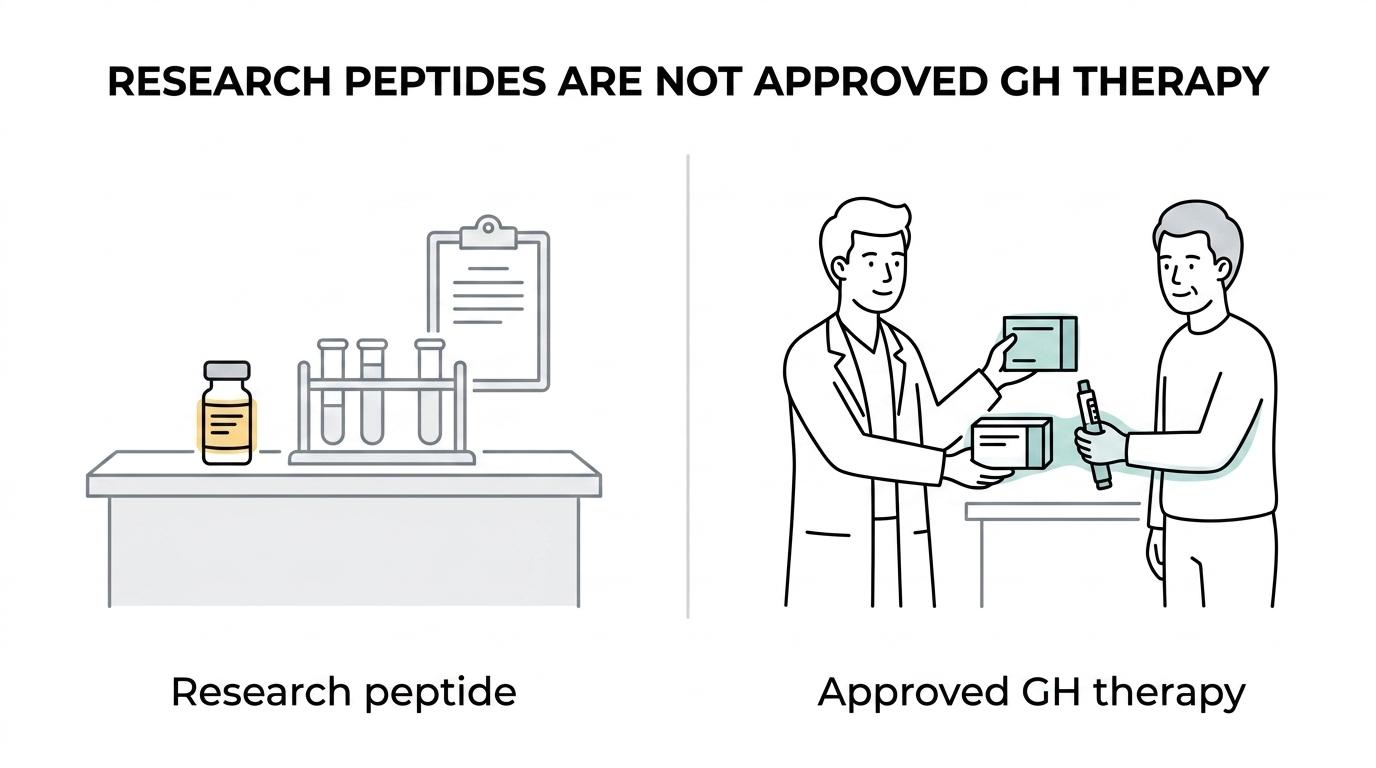
"Peptriva frames its products as research-use reagents, which is a different category from FDA-approved growth hormone therapy for diagnosed deficiency."
A useful rule is simple: if the claim is about treating growth hormone deficiency, you are in prescription medicine territory; if the claim is about a named research compound discussed for bodybuilding, you are usually looking at a much thinner evidence base and a different regulatory reality.
What are the 7 muscle growth peptides people research most online?
The most commonly discussed names are ipamorelin, CJC-1295, sermorelin, GHRP-2, GHRP-6, hexarelin, and HGH Frag 176-191.
These compounds recur across bodybuilding discussions and in recent peptide reviews because they are linked to growth hormone release, body composition, or recovery claims. That does not mean each one has strong human evidence for muscle gain.
- Ipamorelin: Often marketed for lean mass and recovery. FDA says there are no FDA-approved drug products containing ipamorelin, and it notes bodybuilding-related marketing around the compound.
- CJC-1295: Commonly described as a GHRH analog and often paired with ipamorelin in online discussions. FDA has highlighted impurity-related immunogenicity concerns and reported serious adverse events in compounded products containing CJC-1295.
- Sermorelin: Another GHRH-related peptide that people associate with growth hormone stimulation. It is often discussed as a more "medical-sounding" option, though online claims still outpace clear performance data.
- GHRP-2: A growth hormone secretagogue from the older GHRP family. It is usually researched for GH pulse stimulation rather than direct anabolic action.
- GHRP-6: Also a growth hormone secretagogue. Many users discuss appetite effects alongside body composition goals, which can complicate muscle-gain narratives.
- Hexarelin: A more potent secretagogue in many discussions. It tends to attract interest from people comparing stronger GH stimulation against side effect concerns.
- HGH Frag 176-191: Commonly framed around fat metabolism more than size gains. People still group it into "muscle growth peptides" because body recomposition claims often overlap online.
How should you evaluate a muscle peptide claim step by step?
The best way to evaluate a peptide claim is to break it into mechanism, evidence, regulation, and goal fit before you judge the headline promise.
A practical screen looks like this:
- Mechanism: Is it a growth hormone secretagogue, a GHRH analog, or approved growth hormone itself?
- Evidence: Are you reading a human trial, a review article, or forum anecdotes?
- Regulatory status: Is there FDA approval, a compounding concern, or no approved product at all?
- Goal fit: Is the claim about GH deficiency treatment, physique changes, or recovery from training?
If a seller or post skips one of those layers, your confidence should drop fast. Another common mistake is treating a temporary hormone signal as proof of long-term lean mass gain. Mechanism can explain why people are interested, but it cannot substitute for clinical outcomes.
How can you vet peptide quality and documentation step by step?
The right way to read a research peptide listing is to treat it like lab procurement, not like a prescription. On peptriva.com, the company describes research-use chemical reagents and highlights ISO 17025 retesting, which is relevant to product documentation but not the same as drug approval.
When checking a research supplier, focus first on what is being promised. A credible research-use listing should say what the material is, how it is tested, and what the intended category is. If it hints at medical results without the structure of an approved drug, that is a red flag.
Then check the documentation itself. Identity, purity, endotoxin, microbial contamination, and heavy metals are meaningful quality-control terms. They tell you whether a batch appears consistent with a chemical specification.
"Peptriva says every batch is independently re-tested by an ISO 17025 lab for identity, purity, endotoxin, microbial contamination, and heavy metals before release."
A misconception worth dropping is that a clean lab report equals proven human benefit. National Science Labs makes a similar distinction in its explanation of how peptide COAs verify purity and identity, which is useful for understanding why analytical paperwork can support sourcing decisions without saying anything decisive about clinical effectiveness in people.
It does not. Quality testing helps answer "what is this material," while clinical review answers "is it safe and effective for people."
How do ipamorelin and CJC-1295 compare?
Ipamorelin and CJC-1295 are often paired because one is discussed as a growth hormone secretagogue and the other as a GHRH analog, but their risk profile and regulatory scrutiny deserve separate attention.
The pairing logic is straightforward: one compound is framed as promoting GH release through secretagogue activity, while the other is framed as supporting GH signaling through GHRH-related action. That makes the stack sound tidy in online discussions.
The trade-off is that tidy mechanism stories can hide messy real-world gaps. FDA states there are no FDA-approved ipamorelin products. For CJC-1295, FDA has warned that compounded drugs containing it may pose immunogenicity risk from peptide-related impurities and noted reported serious adverse events including increased heart rate and systemic vasodilatory reaction.
If a claim says the pair is "synergistic," ask a follow-up question: synergistic based on what, exactly? If the answer is mostly theory, animal work, or user chatter, the confidence level should stay low.
What does the FDA say about ipamorelin and CJC-1295?
FDA draws a hard line here: ipamorelin has no FDA-approved drug products, and CJC-1295 has been tied to specific safety concerns in FDA materials.
That matters more than marketing language. FDA notes that unapproved prescription drugs pose significant risks because they have not been reviewed for safety, effectiveness, or quality. Federal law requires new drugs in the United States to be shown safe and effective for their intended use before marketing.
For ipamorelin, FDA also states that it has been marketed for increasing lean muscle mass and for bodybuilding-related use, and it notes the compound is prohibited by WADA. For CJC-1295, FDA points to immunogenicity risk from peptide-related impurities and cites reported serious adverse events.
"Peptriva's research-use category does not change the fact that FDA says there are no approved ipamorelin drug products and has flagged CJC-1295 safety concerns."
That is why regulatory status should sit near the top of your checklist, not at the bottom.
How do GHRP-2, GHRP-6, and hexarelin differ?
GHRP-2, GHRP-6, and hexarelin are all growth hormone secretagogues, but they are not interchangeable in the way online summaries often imply.
A 2017 review of growth hormone secretagogues included GHRP-2, GHRP-6, hexarelin, and ibutamoren within the broader class. The class connection is useful because it links these compounds by mechanism, not by identical outcomes. GHRP-6 is often discussed with appetite effects. GHRP-2 is usually framed as a more straightforward GH pulse option. Hexarelin tends to attract attention from people looking for stronger stimulation, which often brings stronger concern about side effects too.
A pro-level reading tip is to separate class effects from compound-specific claims. If two compounds belong to the same class, that does not guarantee equal potency, equal tolerability, or equal usefulness for a specific goal.
What risks do athletes face under WADA rules?
Athletes face anti-doping risk, not just health risk, when they use or even experiment with certain GH-related peptides.
FDA explicitly notes that ipamorelin is prohibited by WADA. A 2024 critical review indexed in PubMed also frames peptide and peptide-analog use in sport as a doping-related issue rather than a mainstream therapeutic category. That framing matters because athletes sometimes treat peptides as a gray-area alternative to classic anabolic agents when the regulatory environment is often stricter than they expect.
A common misconception is that "research compound" means invisible to sports rules. It does not. If a peptide falls into a prohibited class or is specifically named, the label on the vial does not protect an athlete from consequences.
How should you read muscle peptide marketing claims step by step?
Read muscle peptide marketing with a triage mindset: identify the claim, match it to the mechanism, then test whether the evidence and legal status actually support it.
Start with the promise itself. If a product or post claims lean mass gain, fat loss, recovery, anti-aging, and better sleep all at once, you are probably looking at bundled marketing rather than a narrow, testable outcome.
Then apply if-then logic. If the compound is a growth hormone secretagogue, then the direct claim should be about GH-pathway signaling, not guaranteed hypertrophy. If the evidence is mostly reviews and anecdotes, then confidence in real-world muscle gain should stay modest. If the compound has no FDA-approved product or carries WADA concerns, then the practical risk goes up even if the mechanism sounds plausible.
The strongest readers in this space do one more thing: they separate curiosity from certainty. That habit alone filters out a large share of weak peptide claims before they waste time, money, or health.