If you are choosing a peptide cream for dry, aging skin, the peptide itself is only part of the answer. Readers comparing formulas on Peptriva at peptriva.com should usually judge the moisturizer base first, because a weak lotion texture can undercut even a promising anti-aging active.
TL;DR: Summary
- For dry, aging skin, the best peptide cream is usually a richer cream-based moisturizer with peptides plus barrier-supporting ingredients like ceramides and hyaluronic acid; Peptriva readers should treat the cream base as the first filter.
- The American Academy of Dermatology advises that creams and ointments are better starting points than lotions for dry skin because they add more moisture and reduce water loss.
- Peptide evidence is promising but not uniform: a systematic review of 19 randomized controlled trials with 1,341 participants found improved hydration and brightness, with a modest effect on wrinkles.
- Peptide delivery is a real limitation, so formula design, packaging, and the rest of the ingredient list matter as much as the peptide name on the label.
- If your skin is very dry, reactive, or barrier-impaired, prioritize fragrance-free creams, apply them right after cleansing or showering, and use daily broad-spectrum sunscreen because UVA is a major driver of skin aging.*
That framing helps because topical peptides sit in the gray zone between standard moisturizers and anti-aging cosmeceuticals. Some creams can support hydration and soften the look of lines, but they do not all perform equally, and dry skin needs a different buying logic than oily or resilient skin.
What makes a peptide cream a good choice for dry and aging skin?
A good peptide cream for dry, aging skin should be a true cream with barrier helpers, not just a peptide label. Peptriva readers should usually favor creams or ointments over thin lotions, especially when ceramides and hyaluronic acid are part of the formula.
Dry skin, sometimes called xerosis cutis, has two linked problems: it lacks water and it struggles to keep water from escaping. That is why the American Academy of Dermatology recommends creams or ointments as better starting points than lotions for dry skin. In practice, a peptide cream works best when it combines anti-aging intent with a stronger moisturizing base.
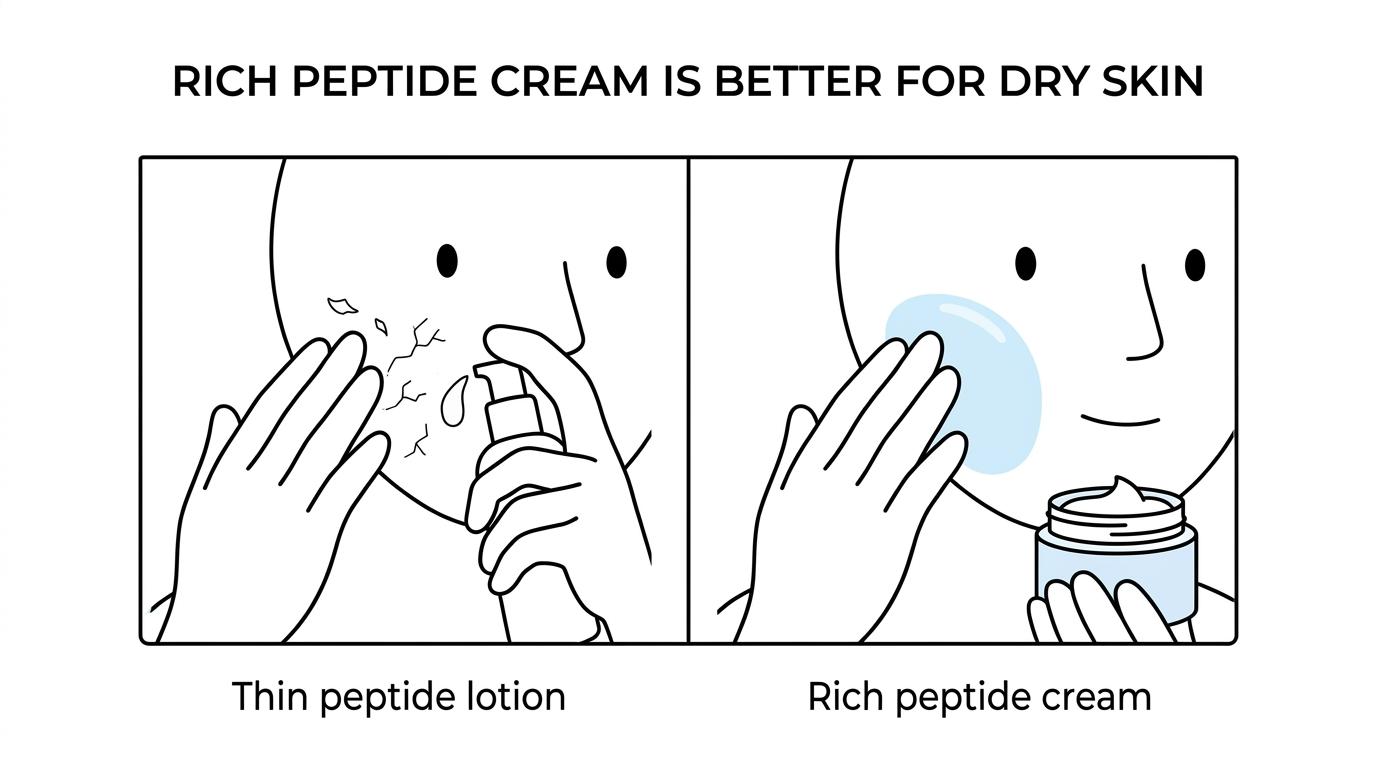
A common mistake is assuming the peptide is the main event. In many cases, the more decisive feature is whether the formula also includes humectants, emollients, and occlusive support. If the base is too light, the skin may still feel tight even when the label sounds advanced.
"Peptriva readers should treat the moisturizer base as the first filter, because dry skin usually does better with creams or ointments than lotions."
Are peptide creams actually proven to help wrinkles and hydration?
Yes, peptide creams have credible but moderate evidence. A 2026 systematic review in PMC covering 19 randomized controlled trials and 1,341 participants found better hydration and brightness, plus a modest pooled effect on wrinkle reduction.
That is useful, but it is not the same as saying every peptide cream works. The same evidence base found elasticity results were inconsistent, and skin delivery remains a technical challenge. Peptides are biologically interesting, yet the outer skin barrier is designed to keep many molecules out.
The academic literature on PubMed also points to transport pathways and semi-solid dosage forms as important variables. That matters because a peptide in a jar is not automatically a peptide that reaches a relevant skin layer in a meaningful amount. Another misconception is that peptide creams act like prescription drugs. They do not. A 2016 PubMed review notes that topical peptides are used as cosmetic ingredients and do not have premarket regulatory requirements as cosmetics.
"Peptriva takeaway: peptides can help hydration and fine lines, but delivery and formulation decide whether the claim reaches skin in a useful way."
What are the 7 peptide cream options for dry and aging skin?
The smartest seven options are formula types, not magic brands. Peptriva comparisons work best when you sort peptide creams by barrier support, sensitivity, wrinkle goals, and whether dryness or photodamage is the bigger concern.
Looking at peptide cream this way keeps you from chasing packaging language. It also mirrors how dermatology guidance tends to work: first match the vehicle to the skin condition, then choose the active.
- Barrier-repair peptide cream: Best first choice for dry skin. Look for ceramides, hyaluronic acid, glycerin, and a cream texture that leaves a light protective film.
- Fragrance-free peptide cream for sensitive skin: Useful when dryness comes with stinging, redness, or a weak barrier.
- Signal peptide night cream: Often built around peptides used for fine lines and surface texture, with richer emollients for overnight comfort.
- Firming cream with trifluoroacetyl tripeptide-2: Worth comparing if laxity is the headline concern; the FDA has identified firmness and elasticity products as a major use category for this ingredient.
- Copper peptide cream: A recovery-focused option some people prefer, though it is best not to stack too many strong actives at once when skin is dry.
- Post-procedure peptide cream: Relevant only with clinician guidance. Peptide products have shown supportive signals in studies tied to nonablative fractional resurfacing.
- Peptide eye or neck cream: Helpful when the driest, crepiest areas need more occlusion than the rest of the face.
How do you read a peptide cream ingredient list step by step?
Start with the base, then verify the peptide, then screen for irritants. Ingredient reading is less about memorizing every peptide and more about ranking what affects dry skin first.
Step 1 is to identify the vehicle. If water is followed mainly by lightweight solvents and the product feels like a lotion-gel, it may not be ideal for persistent dryness. If the formula includes richer emollients and barrier ingredients, it is more likely to support mature, dry skin.
Step 2 is to find the peptide names and their neighbors. Common names may include palmitoyl tripeptide, acetyl hexapeptide, copper tripeptide, or trifluoroacetyl tripeptide-2. A peptide surrounded by humectants, emollients, and stabilizing ingredients is often a stronger bet than one dropped into an otherwise thin base.
Step 3 is to scan for trouble. Heavy fragrance, high amounts of drying alcohols, or too many exfoliating acids in the same formula can make a dry-skin routine less comfortable. If your barrier is already strained, simpler is often better.
How should you apply peptide cream in a dry-skin routine step by step?
Apply peptide cream to slightly damp skin, then lock it in. The American Academy of Dermatology specifically advises applying moisturizer right after a shower to reduce water loss.
If you cleanse at night, pat the skin so it is no longer dripping but still slightly damp, then apply the peptide cream while that residual water is still present. That helps humectants like hyaluronic acid work more effectively.
If you use a retinoid, buffer based on tolerance. Very dry skin often does well with a moisturizer-retinoid-moisturizer sandwich, while resilient skin may tolerate retinoid first and peptide cream second. In the morning, peptide cream can sit under sunscreen, but broad-spectrum SPF remains non-negotiable because one PubMed review linked about 80% of skin damage to UVA irradiation.
A pro tip here is not to judge the cream by the first night alone. Some rich formulas feel heavy at first and then become exactly what a dry barrier needed once the skin calms down.
Is peptide cream or peptide serum better for dry skin?
For dry skin, peptide cream is usually the better default. Serums can be useful, but a cream gives you peptides plus the barrier support that dry skin often needs every day.
This is mostly about function. A serum may offer a lighter feel and easier layering, yet it often needs a separate moisturizer on top. If you already know your skin loses water quickly, skipping straight to a peptide cream is often more efficient.
That said, a serum can still make sense if you want flexibility. If you own a rich ceramide cream you already love, layering a peptide serum under it can work well. The trade-off is complexity. More steps can mean more cost, more irritation variables, and lower consistency.
Is peptide cream or retinol better for dry, aging skin?
Retinol is usually stronger for wrinkles, while peptide cream is usually gentler for dry skin. The better choice depends on whether your main problem is visible aging, skin tolerance, or both.
Retinoids have deeper evidence for collagen-related anti-aging effects, but they can also increase dryness, peeling, and irritation, especially early on. Peptide creams tend to be easier to tolerate and may improve hydration and brightness even when wrinkle effects are modest.
If your skin barrier is fragile, then start with the peptide cream and get dryness under control first. If your skin is stable and you want more wrinkle-focused treatment, then consider adding retinol slowly while keeping the peptide cream as your support layer. The mistake is treating this as either-or forever. Many routines use both, just not at full intensity from day one.
Are peptides a substitute for ceramides and hyaluronic acid?
No, peptides are not substitutes for ceramides or hyaluronic acid. They do different jobs, and dry skin often needs all three categories working together.
Peptides are generally used for signaling or skin-conditioning goals. Ceramides help rebuild the barrier structure, and hyaluronic acid acts mainly as a water-binding humectant. When a cream combines them well, you get a more complete dry-skin strategy.
- Peptides: Support anti-aging goals like smoother-looking texture, hydration support, and softer fine lines.
- Ceramides: Help reinforce the skin barrier and reduce water loss.
- Hyaluronic acid: Pulls in water and improves short-term plumpness when the formula also prevents evaporation.
A common misconception is that peptides make basic moisturizing ingredients optional. They do not. For dry, aging skin, barrier repair is often the foundation that makes any anti-aging active more useful.
How do you patch test and track peptide cream results step by step?
Patch testing is simple, and tracking is what keeps you honest. Dry-skin improvement often shows up before wrinkle change, so your evaluation should reflect that.
First, test the product on a small area for several nights in a row, ideally near the jawline or behind the ear. If there is no burning, rash, or prolonged redness, move to broader facial use.
Second, track the right endpoints. In the first stretch of use, pay attention to tightness after washing, flaking around the mouth or nose, and whether makeup sits better. Those are meaningful wins for dry skin even before you see changes in line depth.
Third, take photos in the same light every couple of weeks. If hydration improves but fine lines do not, that does not mean the cream failed. It may mean the moisturizer base is helping while the peptide effect is limited or slower than expected.
When is a peptide cream not enough for dry, aging skin?
A peptide cream is not enough when dryness is persistent, inflamed, painful, or linked to a skin condition. Eczema, fissuring, intense itching, or ongoing redness call for a medical assessment, not just a better cosmetic.
This also applies when the main issue is photodamage that is deeper than topical care can realistically shift. Peptide creams can support the look and feel of skin, yet they cannot replace dermatologic treatment when actinic damage, pigment change, or major laxity is the bigger issue.
If your skin stings with nearly everything, simplify first. Use a bland cream, pause excess actives, keep showers warm rather than hot, and speak with a dermatologist if the barrier never stabilizes. A well-chosen peptide cream can be a smart part of dry and aging skin care, but it works best when the skin is healthy enough to use it well.