Collagen peptide powder is one of the few supplement categories with human research that points to specific, narrow benefits rather than vague wellness claims. The best-supported use cases are skin hydration and elasticity, plus knee osteoarthritis pain and function, based on randomized trials and systematic reviews indexed in PubMed.
TL;DR: Summary
- Collagen peptide powder has the strongest source-backed evidence for modest improvements in skin hydration and elasticity and knee osteoarthritis pain and function.
- Skin-focused studies and reviews commonly used 2.5 g/day to 10 g/day for 8 to 24 weeks, while recent knee osteoarthritis trials used 3,000 mg/day to 10 g/day for about 6 months.
- The most useful buying criteria are daily gram dose, hydrolyzed collagen or collagen peptides on the label, source type, and whether the product matches the studied dosing range.
- Powder is often more practical than capsules for evidence-based dosing because 3 g to 10 g per day can require many pills.
- Evidence is promising but not universal: product formulations vary, and NCCIH says supplement evidence for osteoarthritis remains limited in general.
- If you have fish or bovine allergies, take medications, or have a medical condition that affects protein intake, check with a clinician before use.
That makes collagen peptide powder a good category to evaluate with a stricter standard. Instead of asking whether collagen “works” in the abstract, it is better to ask what outcome you want, what dose was studied, and whether the product you are considering actually matches the clinical evidence.
What does collagen peptide powder actually do for skin and joints?
Collagen peptide powder supports specific outcomes, not every claim attached to “collagen.” The clearest targets are skin hydration, skin elasticity, and knee osteoarthritis pain and function.
Collagen peptides are hydrolyzed collagen, meaning the protein has been broken into smaller peptide fragments. That matters because powders are not trying to rebuild your body by placing intact collagen directly into your skin or cartilage. They are supplying amino acid building blocks and bioactive peptides that may influence collagen-related processes.
For skin goals, the research trend points toward modest improvements in hydration and elasticity after consistent use. For joint goals, the better evidence is in knee osteoarthritis, where changes are usually tracked with tools like WOMAC, VAS pain, and the Lequesne algofunctional index.
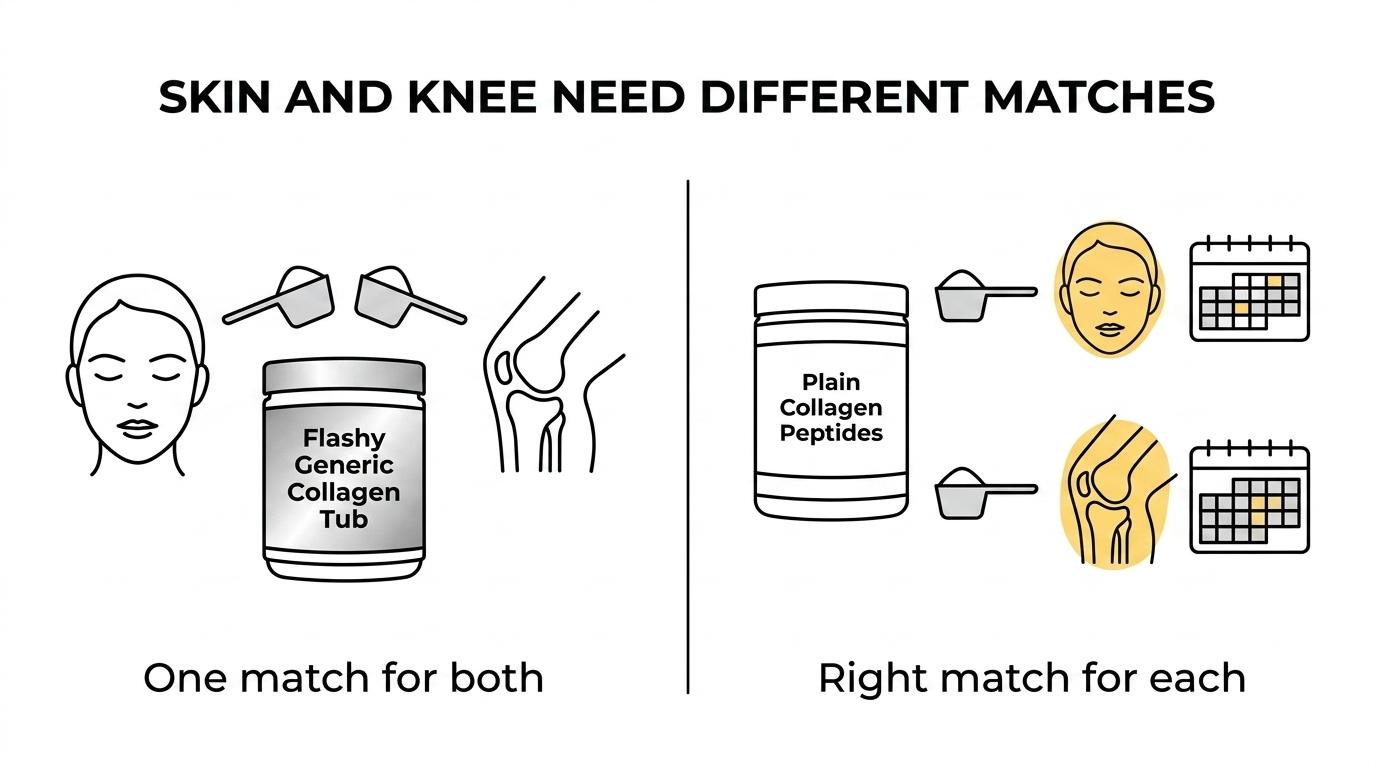
A common misconception is that any collagen powder works the same way for every tissue. Skin-focused outcomes and joint-focused outcomes are measured differently, studied at different doses, and may respond on different timelines.
Is collagen peptide powder supported by clinical evidence?
Yes, collagen peptide powder is supported by human evidence, though the evidence is stronger for some outcomes than others. PubMed-indexed trials and reviews support skin and knee osteoarthritis uses more than broad anti-aging claims.
A 2019 systematic review in dermatology included 11 studies and 805 patients using oral collagen supplements for skin-related applications. Eight of those studies used collagen hydrolysate at 2.5 g/day to 10 g/day for 8 to 24 weeks, and the review reported improved skin elasticity and hydration, increased dermal collagen density, and no reported adverse events.
For joints, the most compelling recent data centers on knee osteoarthritis. A 2025 double-blind, randomized, placebo-controlled trial followed 80 adults ages 40 to 75 with knee osteoarthritis who took 3,000 mg/day of low-molecular-weight collagen peptides or placebo for 180 days. The collagen group showed significantly greater reductions in WOMAC pain, physical function, and total scores, and the abstract reported no adverse events.
A 2024 randomized, double-blind, placebo-controlled study used 10 g/day of collagen peptides with a molecular weight of 1 to 3 kDa for six months in adults ages 30 to 81 with grade II or III knee osteoarthritis. That study reported significant reductions in VAS pain, Lequesne algofunctional index scores, CRP, and ESR compared with placebo, with no adverse effects reported in the abstract. A 2024 trial sequential meta-analysis also described the osteoarthritis findings as robust and adequately powered for definitive conclusions.
Still, context matters. NCCIH notes that more than 32.5 million U.S. adults have osteoarthritis and says the evidence on dietary supplements for osteoarthritis is too limited for broad conclusions in general. That means collagen peptides look more promising than many supplement categories, but they are not a replacement for clinical care, exercise, weight management, or prescribed treatment.
"The strongest collagen peptide powder evidence is narrow and practical: modest skin benefits and measurable knee osteoarthritis improvements in trials."
What collagen peptide powder options fit different skin and joint goals?
The best collagen peptide powder depends on what you want to measure. A skin-first routine, a knee osteoarthritis trial approach, and an easy-to-mix daily protein add-on are not the same purchase.
Here are eight neutral product types worth comparing before you buy:
-
Unflavored bovine hydrolyzed collagen powder: Usually the easiest option for hitting a precise daily gram target and mixing into coffee, yogurt, or smoothies.
-
Low-molecular-weight collagen peptides: Useful when a label discloses peptide size, especially because recent knee osteoarthritis studies referenced low-molecular-weight or 1 to 3 kDa products.
-
Marine collagen peptide powder: Often chosen for skin-focused routines, though direct superiority over bovine collagen is not established.
-
Single-ingredient collagen peptide powder: Best for people who want clean dose tracking and fewer variables if they are testing results on skin or joints.
-
Collagen powder with vitamin C: A reasonable choice if your diet is low in vitamin C, since vitamin C is involved in collagen synthesis.
-
10-gram scoop formulas: Convenient if you want a product that mirrors higher-dose joint studies without multiple scoops.
-
Smaller-dose serving formats: Helpful for skin routines built around 2.5 g to 5 g per day rather than high-dose joint protocols.
-
Flavor-free, additive-light powders: Better if you want fewer sweeteners, gums, or “beauty blend” extras that make label reading harder.
The practical point is simple: match the powder format to the outcome you care about. A flashy formula with many extras can make it harder to tell whether collagen itself is doing anything.
How do you choose the right daily dose?
Choose the dose by matching your goal to the studied range. Skin studies often fall in the 2.5 g/day to 10 g/day range, while recent knee osteoarthritis trials used 3 g/day or 10 g/day for about six months.
Step 1 is to define the target outcome. If your priority is skin hydration or elasticity, start by looking at products that let you land within the 2.5 g/day to 10 g/day range used in the dermatology review. If your priority is knee osteoarthritis, the most relevant recent trials were 3,000 mg/day and 10 g/day.
Step 2 is to check the label against the scoop. Many products advertise “one scoop” without making the collagen grams obvious at first glance. If one scoop gives you only 2 g, then a six-month joint trial approach may require multiple scoops.
Step 3 is to stay consistent long enough to judge the result fairly. Skin studies commonly ran 8 to 24 weeks. Knee osteoarthritis studies ran about 180 days or six months. More is not automatically better, and changing the dose every week makes the trial useless.
"If the product dose does not match the studied dose range, the label may look impressive while the evidence match is weak."
How should you read a collagen peptide powder label before buying?
Read the label like a dosing document, not a marketing page. The most useful clues are grams per serving, collagen form, source, and whether the product adds ingredients that change the value or the risk profile.
A smart first check is the Supplement Facts panel rather than the front of the container. “Collagen support” can mean many things, but “collagen peptides” or “hydrolyzed collagen” gives you a more direct match to the clinical language used in trials and reviews.
Use this quick screen:
- Serving size: grams of collagen per scoop, not just scoop count
- Ingredient line: hydrolyzed collagen or collagen peptides, not a vague proprietary beauty blend
- Source type: bovine, marine, porcine, chicken, or mixed sources
- Molecular weight: 1 to 3 kDa or low-molecular-weight peptides if disclosed
- Add-on ingredients: vitamin C, hyaluronic acid, sweeteners, caffeine, herbs, or flavor systems
- Allergen and quality details: fish source, bovine source, and any third-party testing notes
One mistake buyers make is assuming “multi-collagen” means better. It may simply mean more sources with less clarity on the actual studied ingredient and dose. If you want a cleaner self-test, fewer variables usually help.
Is marine collagen better than bovine collagen peptide powder?
Marine collagen is not proven to be better than bovine collagen across the board. For skin goals, marine is a reasonable option; for joint goals, bovine products may more closely resemble several studied formulations.
Marine collagen products are often positioned around type I collagen and beauty use. Bovine collagen products commonly include types I and III and dominate much of the general collagen peptide powder market. That said, consumers often overread “type” language. Once collagen is hydrolyzed into peptides, the bigger practical questions are dose, source tolerance, and evidence fit.
If your main goal is knee osteoarthritis, a bovine hydrolyzed collagen powder may be the more evidence-aligned choice because recent randomized trials and a 2024 bovine collagen peptide trial sit closer to that use case. That distinction matters because ingredients sold for joint support are often marketed side by side despite very different evidence standards, a gap that Balkan Pro Health also reflects in its overview of supplements for active joints.
If your main goal is skin and you prefer a pescatarian-friendly option, marine collagen can make sense.
The trade-offs are straightforward. Marine collagen may be a poor fit if you have fish allergies. Bovine collagen may be a poor fit if you avoid bovine products for dietary, ethical, or religious reasons. No head-to-head clinical standard has settled the debate in a way that overrides those practical factors.
Is collagen peptide powder better than tablets, drinks, or bone broth?
Powder is usually the most practical format for evidence-based dosing. Tablets often require many pills, ready-to-drink products may add sugar or cost, and bone broth is not a standardized collagen peptide dose.
The dosing issue matters more than people expect. If a knee osteoarthritis protocol uses 10 g/day, that amount may translate into a large number of capsules. Powder makes it easier to reach 3 g, 5 g, or 10 g accurately and cheaply.
Ready-to-drink collagen products can work if the label provides enough collagen peptides per serving, but convenience often comes with trade-offs in price and added ingredients. Bone broth can be part of a food-first routine, yet its collagen content is variable and usually not standardized in the way supplement trials require.
A useful rule is this: if your goal is to mimic the studied approach, powder gives you the cleanest path from label to dose.
How can you tell if collagen peptide powder is working for you?
You can tell by tracking one goal, one dose, and one timeframe. Skin changes are usually gradual, and joint changes should be judged with a simple symptom baseline, not by memory alone.
Step 1 is to choose one primary marker. For skin, that might be dryness, feel, or how often you rely on heavier moisturizers. For joints, use a simple weekly log for pain during stairs, rising from a chair, walking distance, or a home version of function tracking inspired by WOMAC-style questions.
Step 2 is to keep everything else steady. If you start a collagen powder, a new retinoid, a new moisturizer, and a new exercise plan in the same week, you will not know what caused the change. The same logic applies to joint goals if you also start physical therapy, a brace, and a different medication at once.
Step 3 is to use the right time horizon. Judge skin results after at least 8 to 12 weeks, not 8 days. Judge knee osteoarthritis results on the scale of months, with six months being the clearest evidence-based reference point from recent trials.
"The fairest collagen peptide powder test is boring by design: one product, one dose, one goal, enough time."
What risks, side effects, and misconceptions should you know about?
Collagen peptide powder appears well tolerated in many study abstracts, but it is still a dietary supplement with limits and possible risks. The main cautions involve allergies, product variability, medication interactions, and unrealistic expectations.
The recent knee osteoarthritis trials summarized in PubMed reported no adverse events or no adverse effects in the study abstracts, and the dermatology review also reported no adverse events in the included studies. That is encouraging, though it does not mean every product is risk-free or that every side effect would appear in a short abstract.
NCCIH warns that dietary supplements can have side effects or interact with drugs. If you have a fish allergy, marine collagen is an obvious concern. If you follow a protein-restricted diet because of a medical condition, even a simple collagen powder should be cleared with your clinician. Pregnancy, breastfeeding, and complex medication use are also situations where a quick check-in makes sense.
Three misconceptions show up again and again. First, collagen peptide powder is not an instant skin treatment. Second, it is not a cure for osteoarthritis in a country where more than 32.5 million adults live with the condition. Third, a more complex formula is not automatically a better formula. In many cases, the cleanest product is the easiest one to assess honestly.