Online peptide shopping puts very different products into the same search results. Semaglutide, tirzepatide, BPC-157, TB-500, and semax are often discussed side by side, but their evidence base, regulatory status, and product-quality risk are not remotely equal.
TL;DR: Summary
- When comparing research peptides online, the first and most important split is between FDA-approved GLP-1 drugs like semaglutide and tirzepatide and investigational peptides like BPC-157, KPV, TB-500, MOTS-c, epitalon, semax, and emideltide.
- FDA says semaglutide sodium and semaglutide acetate are different active ingredients from approved semaglutide and says it is not aware of a lawful basis for using those salt forms in compounding.
- FDA’s 2026 peptide-compounding review groups BPC-157, KPV, TB-500, MOTS-c, emideltide, epitalon, and semax for 503A bulk-drug discussion, and FDA proposes that BPC-157 and KPV not be included on the 503A Bulks List.
- Human data are uneven: BPC-157 has very limited indexed human exposure data, while FDA says it has not identified human exposure data for KPV or MOTS-c administered by any route.
- If a listing uses terms like research use only, promotes human dosing, substitutes salt forms, or shows a non-batch-specific COA, treat it as a higher-risk purchase decision.*
That difference matters more than marketing language. A smart comparison starts with four filters: approval status, active ingredient identity, human safety data, and whether FDA has already flagged the peptide or dosage form for compounding concerns.
What is the biggest difference between approved GLP-1 drugs and research peptides?
Yes, semaglutide and tirzepatide are in a different category from BPC-157 and semax. FDA-approved drugs have labeled indications, manufacturing controls, and postmarket safety systems; most other peptides sold online remain investigational or are under active FDA compounding scrutiny.
This is the point many buyers miss. “Peptide” describes a molecular class, not a quality level or evidence standard. An approved GLP-1 drug product sits inside a formal regulatory framework. A research peptide listing may sit outside that framework entirely, even when the product page looks polished.
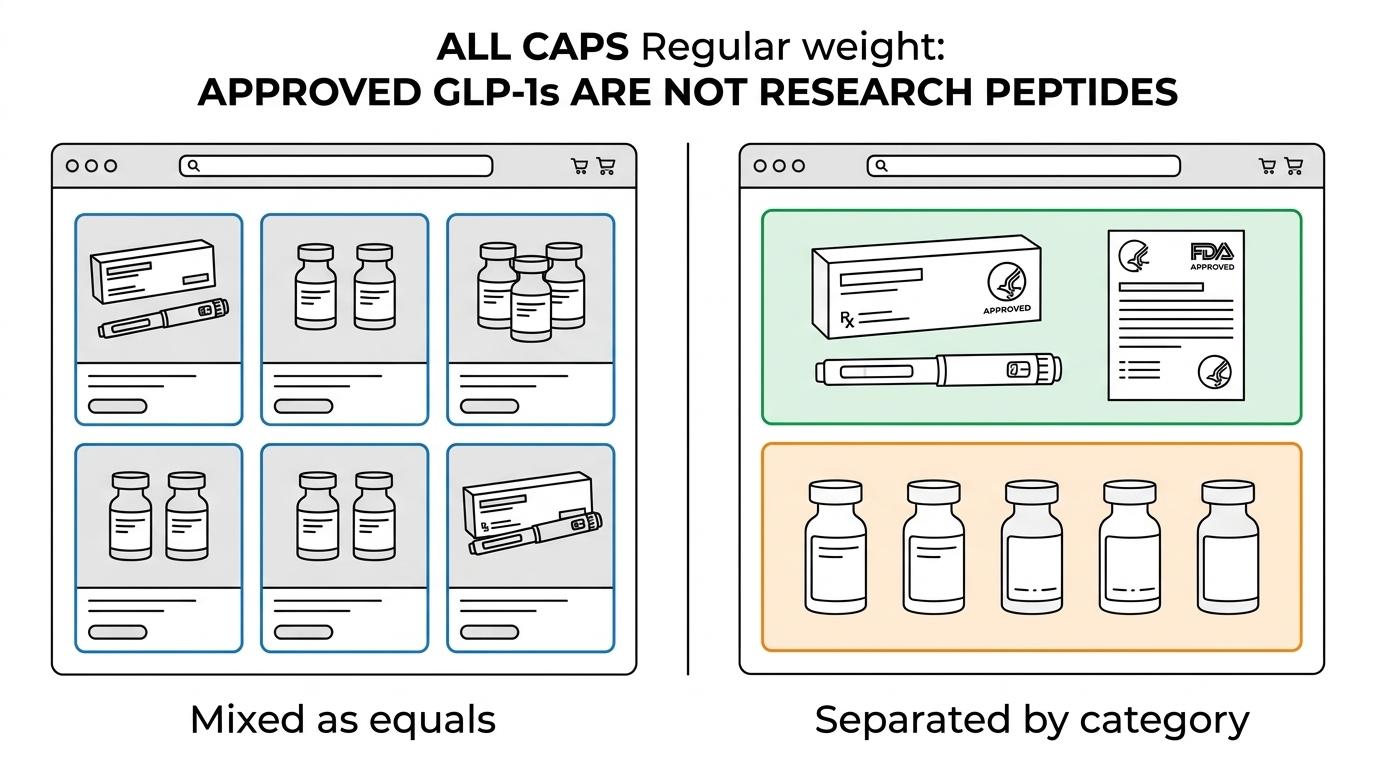
If you are comparing online options for weight loss or diabetes care, approved semaglutide and tirzepatide products are the benchmark. If you are comparing peptides marketed for recovery, repair, focus, or longevity, you are usually looking at compounds with much thinner human evidence and fewer safeguards around identity, impurities, sterility, and adverse-event reporting.
"FDA says semaglutide sodium and semaglutide acetate are different active ingredients from those used in approved semaglutide drugs."
How can you tell whether a peptide listing is FDA-approved, compounded, or investigational?
You can usually classify a peptide listing in three checks: ingredient name, drug-status claim, and evidence language. Ozempic/Wegovy style labeling points one way; BPC-157 acetate or research use only points another.
Step 1 is to read the exact active ingredient, not just the headline. “Semaglutide” is not the same as “semaglutide sodium” or “semaglutide acetate.” FDA explicitly distinguishes those salt forms from the active ingredients used in approved drugs. A small wording change can signal a major regulatory difference.
Step 2 is to inspect the status claim. If a page says “FDA approved,” there should be a real approved drug identity behind that claim, not a generic peptide vial or a compounded copy presented as equivalent. If the page talks about custom compounding, research supply, or peptide stacks, it is not presenting the same thing as an approved branded drug.
Step 3 is to examine the proof style. Approved drugs come with labeling, contraindications, and structured safety information. Investigational peptide sellers often lean on theory, before-and-after language, animal data, or broad claims like “repair,” “optimize,” or “support recovery.” A common misconception is that a certificate of analysis fixes this gap. It does not.
What are the 9 research peptides people compare before buying online?
These nine names show up repeatedly in online peptide comparisons. Semaglutide and tirzepatide are the outliers because approved drug versions exist; the others are generally discussed as investigational peptides or candidates under FDA compounding review.
- Semaglutide: Approved drug versions exist, but online risk rises when listings use compounded or salt-form variants like semaglutide sodium or semaglutide acetate.
- Tirzepatide: Approved drug versions exist, yet compounded versions still raise safety and reporting concerns, including likely underreported adverse events.
- BPC-157 / BPC-157 acetate: Investigational peptide with limited indexed human data; FDA proposes BPC-157 free base and acetate not be included on the 503A Bulks List.
- TB-500: Investigational peptide often marketed for recovery; FDA says compounded TB-500 may pose immunogenicity risk tied to aggregation and peptide-related impurities.
- KPV: Investigational tripeptide; FDA says it has not identified human exposure data on drug products containing KPV administered by any route.
- MOTS-c: Investigational mitochondrial peptide; FDA says it has not identified human exposure data on drug products containing MOTS-c administered by any route.
- Semax: Commonly compared in nootropic peptide circles; FDA’s 2026 503A discussion includes semax among candidate bulk substances.
- Epitalon: Often marketed around longevity themes; included in FDA’s 2026 503A peptide discussion and still lacks the profile of an approved mainstream drug.
- Emideltide: Another peptide in FDA’s 2026 503A bulk-drug discussion, which places it squarely in a scrutiny-heavy rather than routine retail category.
How do semaglutide and tirzepatide compare with BPC-157 and TB-500?
They do not compare as substitutes. Semaglutide and tirzepatide are discussed around metabolic disease and weight management; BPC-157 and TB-500 are usually marketed around repair or recovery, with much thinner human evidence.
The most useful comparison is not “which peptide is stronger?” It is “what type of claim is being made, and what level of evidence supports that claim?” Approved GLP-1 drugs have human clinical programs, established dosing frameworks, and formal adverse-event systems. BPC-157 and TB-500 are typically sold into a market where the theory may be stronger than the human dataset.
There is also a quality trade-off. A buyer may assume a small injectable peptide vial is interchangeable with a branded pen because both involve peptides and both can be injected. That is a category error. Mechanism talk is not the same as validated manufacturing, stability data, impurity control, or labeled risk management.
A practical rule helps here: if your goal is a labeled medical outcome like glycemic control or chronic weight management, only compare products within that approved-care pathway. If your goal is experimental recovery or performance support, you are in investigational territory and should treat the uncertainty as part of the product.
Why are BPC-157, KPV, TB-500, and MOTS-c under FDA compounding scrutiny?
FDA is already looking closely at BPC-157, KPV, TB-500, and MOTS-c through the 503A Bulks List process. That matters because bulk-drug eligibility affects whether a substance is viewed as appropriate for routine compounding discussions.
In its July 2026 PCAC briefing materials, FDA grouped BPC-157, KPV, TB-500, MOTS-c, emideltide, epitalon, and semax for 503A discussion. The same briefing says FDA is proposing that BPC-157 free base and BPC-157 acetate not be included on the 503A Bulks List, and that KPV free base and KPV acetate also not be included.
The safety rationale is not abstract. FDA says compounded BPC-157 may pose immunogenicity risk and may involve complexities tied to peptide impurities and active pharmaceutical ingredient characterization. FDA says compounded TB-500 may pose immunogenicity risk because of potential aggregation and peptide-related impurities. For KPV and MOTS-c, FDA says it has not identified human exposure data on drug products administered by any route, which is a serious data gap.
"FDA's July 2026 peptide review grouped BPC-157, KPV, TB-500, MOTS-c, emideltide, epitalon, and semax for 503A bulk-drug discussion."
What human safety data actually exists for BPC-157, ipamorelin, and similar peptides?
Human data exist for some peptides, but the record is still thin. BPC-157 has very limited indexed human exposure data, and ipamorelin has at least one randomized proof-of-concept study in a specific postoperative setting.
That distinction matters because many peptide product pages blur “studied somewhere” into “shown safe generally.” A 2025 PubMed-indexed pilot study evaluated intravenous BPC-157 safety in humans, and that study is among the few human BPC-157 studies currently indexed in PubMed. A thin human record is better than none, but it is still a thin record.
Ipamorelin helps show how to read evidence more carefully. A randomized proof-of-concept study evaluated ipamorelin for postoperative ileus after abdominal surgery. The reported treatment-emergent adverse events were 87.5% in the ipamorelin group and 94.8% in the placebo group. That does not mean ipamorelin is “safe for any purpose.” It means a specific study produced a specific safety profile in a specific setting.
A common misconception is that absence of alarming headlines equals safety. In peptide markets, the more honest reading is usually the opposite: absent or sparse human data should increase caution, not lower it.
"A PubMed-indexed ipamorelin study reported treatment-emergent adverse events in 87.5% of the ipamorelin group and 94.8% of placebo."
How should you read a peptide COA, label, or product page before buying?
A COA and a product label can screen out obvious problems, but they cannot turn an investigational peptide into a proven drug. Semaglutide sodium and BPC-157 acetate are good examples of why exact naming matters.
Step 1 is identity. Match the ingredient on the page, the vial, and the COA. If those terms do not match exactly, stop. If the listing implies equivalence between semaglutide salt forms and approved semaglutide, that is a major red flag because FDA says the salt forms are different active ingredients.
Step 2 is traceability. Look for a batch or lot number, the testing lab name, the date, and a method tied to that specific lot. Pro tip: a polished PDF without lot-specific linkage proves very little. That limitation is central to General Peptides' breakdown of what a peptide COA can and cannot verify, especially when lot traceability and method details are missing. It may show that some material was tested at some point, not that your vial was.
Step 3 is scope. A COA may cover identity or assay, but that does not automatically cover sterility, endotoxin, stability, degradation products, or real-world shipping stress. This is especially important with injectable peptides, where purity alone is not the whole risk picture.
What warning signs suggest an online peptide product is higher risk?
Certain patterns are consistently higher risk. FDA and PubMed-indexed reviews point buyers toward the same concern set: ingredient substitution, thin human data, and weak quality transparency.
After checking the ingredient and the drug-status claim, watch for these signs:
- Salt swap: semaglutide sodium or semaglutide acetate marketed as if they are the same as approved semaglutide
- Dual messaging: “research use only” paired with dosing advice for human use
- Traceability gap: generic COA with no lot number, date match, or named testing lab
- Broad therapeutic claims: repair, fat loss, cognition, anti-aging, and inflammation all promised from one listing
- Injectable opacity: no clear disclosure about sterility, endotoxin testing, storage, or shipping controls
- Stack marketing: multiple peptides blended into one vial, making dose attribution and adverse-event tracking harder
A useful misconception to drop is this one: “If it is sold openly online, somebody must have validated it.” Open availability is not validation. In peptides, availability often moves faster than evidence.
Do antidoping rules and professional risk matter when comparing research peptides?
Yes, antidoping and employment risk can matter a lot. BPC-157 and CJC-1295/ipamorelin-type secretagogues sit in categories that a 2026 review says face widespread antidoping restrictions.
That matters even if your main concern is product quality rather than sports compliance. If you compete under WADA-style rules, work in a safety-sensitive field, or face employer testing and disclosure requirements, unapproved peptide use adds another layer of risk. Product contamination, mislabeled identity, and undocumented excipients can all complicate the picture.
The mistake here is assuming “not a steroid” means “not a compliance issue.” Peptide categories can trigger their own restrictions, and a mislabeled online product can create a problem even before any efficacy question is answered.
What is the safest decision process if you are comparing research peptides online?
The safest process is a decision tree, not a brand hunt. Semaglutide and tirzepatide should be routed through licensed medical care; BPC-157 and MOTS-c should be treated as investigational compounds with major data gaps.
A practical screen looks like this:
- If the goal is obesity or diabetes treatment: compare approved-care pathways first, not research peptide listings
- If the ingredient is BPC-157, KPV, TB-500, MOTS-c, semax, epitalon, or emideltide: assume investigational status and weigh that uncertainty directly
- If the listing uses salt forms, vague COAs, or human-use claims under a research label: treat the product as higher risk and walk away
- If sports or workplace compliance applies: verify the rules before purchase, because peptide category risk is not limited to efficacy or side effects
This approach keeps the decision anchored to evidence instead of hype. In peptide buying, the most valuable habit is simple: compare the category first, then the molecule, then the listing.