
If you are exploring peptide injections for recovery, body composition, or broader wellness goals, the most important question is not which peptide is trending. It is whether the injection you are considering is actually supported by meaningful human evidence and appropriate medical oversight.
Our peptide injection service is built for that decision. We help you sort FDA-approved injectable options from investigational or compounded peptides, so you can move forward with a treatment plan that matches your goals, your health history, and the level of evidence behind the product.
Evidence-based peptide injections for wellness and weight-related goals
Not all peptide injections belong in the same conversation. Some, such as certain GLP-1 medicines, have FDA approval for specific uses and were evaluated for quality, safety, and effectiveness. Others are marketed heavily for recovery or wellness even though human data remain limited or the product is compounded rather than FDA-approved.
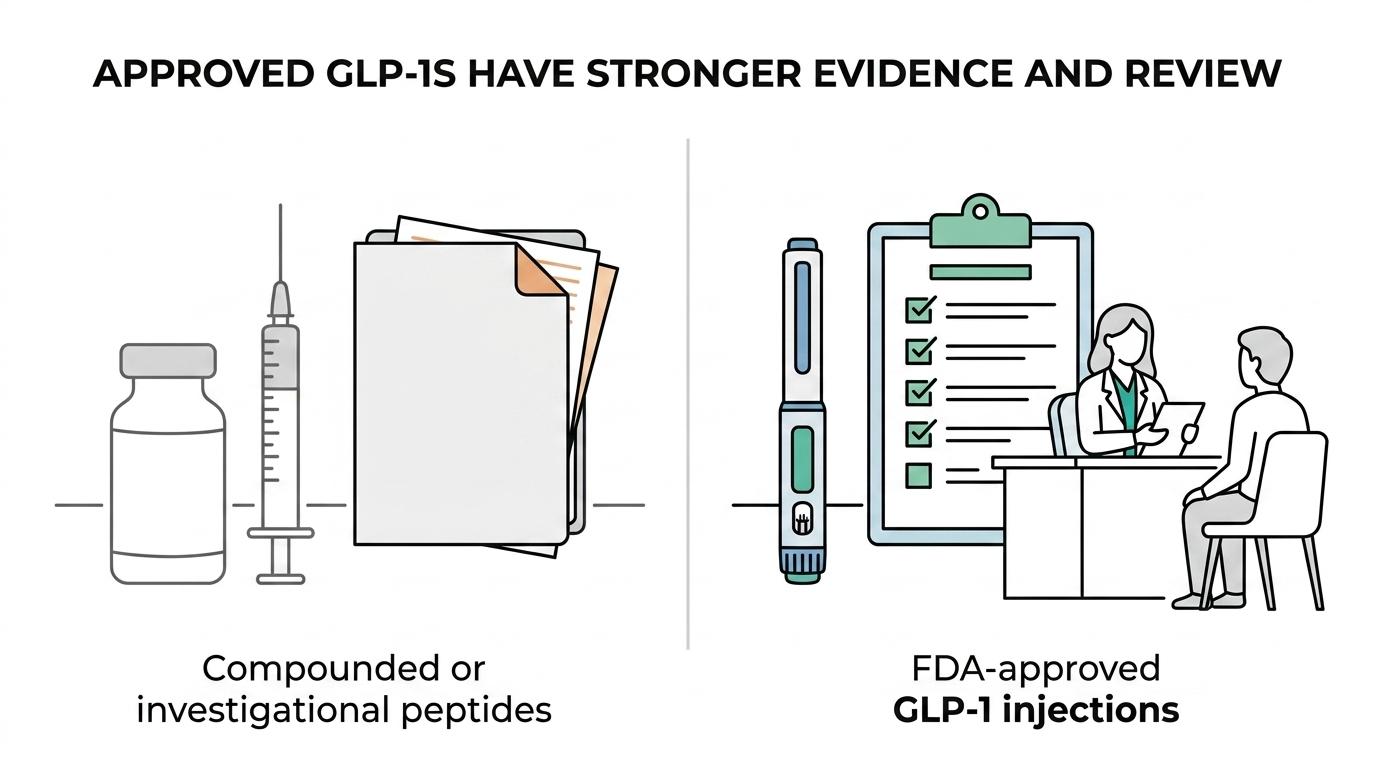
For eligible adults, FDA-approved GLP-1 injections have the strongest regulatory footing in this category. FDA approved tirzepatide injection for chronic weight management in adults with obesity, or overweight with at least one weight-related condition, when used with a reduced-calorie diet and increased physical activity.
We prioritize peptide injections backed by FDA review, including tirzepatide data from 72-week chronic weight management trials.
If you are asking about recovery-focused peptides such as BPC-157, the evidence picture is very different. A 2025 narrative review identified only three pilot human studies for BPC-157 and described the peptide as investigational despite stronger preclinical interest.
We do not present investigational peptides as established care when the published human record includes only three pilot studies.
That distinction protects you from buying into certainty that the research does not support. It also matters from a safety standpoint, because FDA states that compounded drugs do not go through premarket review for safety, effectiveness, or quality.
Who benefits from a peptide injection evaluation before starting treatment
Our peptide injection evaluation is a strong fit if you want a medical answer, not a sales script. We help people who are trying to improve weight-related health, compare approved GLP-1 options with marketed peptide alternatives, or understand whether a recovery or wellness peptide is worth the risk and uncertainty.
Patients often come to us with one of these situations:
- Weight-management interest: You want to know whether an FDA-approved GLP-1 injection may be appropriate for chronic weight management.
- Recovery or wellness questions: You are seeing peptides promoted online and want a direct explanation of what is approved, investigational, or compounded.
- Medication safety concerns: You already take insulin or another insulin-secreting medicine and need to understand how an injectable therapy may affect hypoglycemia risk.
- Evidence-first decision making: You want a clear recommendation based on indication, safety review, and human outcomes, not marketing language.
We are the right fit when you want a real go or no-go decision. That includes telling you when the strongest evidence points toward an approved GLP-1 path and when a recovery-focused peptide simply does not have the human data to justify medical confidence.
We tell you clearly when FDA-approved treatment is the stronger path and when compounded peptides lack premarket review for safety, effectiveness, or quality.
If your goal is proven weight-related improvement, the approved GLP-1 discussion usually deserves to happen first. If your goal is general recovery or wellness, we will explain where the science is still early so you can decide with open eyes.
Peptide injection screening that reduces risk before you commit
Before any peptide injection plan makes sense, you need a careful review of your goals, medical history, and current medications. That is especially important if you take insulin or an insulin-secreting medicine, because FDA notes that dose adjustments may need to be discussed with tirzepatide to help lower hypoglycemia risk.
Your evaluation should make the decision simpler, not more confusing. We focus on the details that change whether an injectable treatment is appropriate:
- Your target outcome: Weight management, appetite control, metabolic improvement, recovery expectations, or general wellness.
- Your current treatment profile: Existing prescriptions, including diabetes medicines that may change risk.
- Regulatory status of the product: Whether the peptide is FDA-approved, unapproved, investigational, or compounded.
- What the treatment requires from you: For approved GLP-1 weight-management use, diet and increased physical activity are part of the treatment, not optional extras.
This process helps you avoid two common mistakes: starting a product that is poorly matched to your goal, or paying for an injection before you understand its evidence level and safety profile. You should know exactly what type of treatment you are considering and what that means for follow-up, monitoring, and expected results.
Approved GLP-1 peptide injections vs compounded or investigational peptides
If you are comparing options, the difference is not just branding. It is the difference between a product reviewed through the FDA approval process and a product that may be promoted without that same level of review.
| Option | Evidence and review status | Typical fit | What that means for you |
|---|---|---|---|
| FDA-approved GLP-1 injections | Reviewed by FDA for quality, safety, and effectiveness for specific indications | Adults who meet criteria for chronic weight management or diabetes-related use, depending on the product | Stronger clinical footing, clearer indication, structured use with diet and activity |
| Compounded peptide injections | Not reviewed by FDA through premarket approval for safety, effectiveness, or quality | Situations where a patient is considering a non-approved route or formulation | More uncertainty about quality, risk, and expected benefit |
| Investigational peptides such as BPC-157 | Limited human data despite preclinical interest | Patients asking about recovery or wellness claims | Important to treat as investigational, not as proven therapy |
This is where many buying decisions go wrong. A peptide can sound advanced while still having limited human evidence, unclear risk, or no FDA review.
FDA has also flagged safety concerns around some compounded injectable peptides. For example, the agency has described potential immunogenicity risk and limited human safety data for compounded injectable GHK-Cu and ipamorelin acetate, which is exactly why product status should be part of the treatment discussion from the start.
What improves when your peptide injection plan is medically supervised
The first improvement is clarity. You know whether you are pursuing an approved treatment with a defined indication or an investigational product with major evidence gaps.
The second improvement is fit. If you qualify for an FDA-approved GLP-1 approach, your plan can be built around the way these medicines are actually intended to be used: with reduced-calorie nutrition, increased physical activity, and ongoing review of tolerance and response.
The third improvement is risk control. Instead of guessing based on forums or social media claims, you get a treatment decision that accounts for medication interactions, expected benefits, and the difference between preclinical promise and real human outcomes.
Just as important, you get honest boundaries. If a peptide is not the right match for your goal, or if the evidence is too limited to justify treatment confidence, we will tell you directly.
Schedule a peptide injection consultation built around evidence, not hype
If you are considering peptide injections for recovery, wellness, or weight-related goals, the next step is a focused evaluation. We will help you understand which injectable options are FDA-approved, which are still investigational or compounded, and which path best fits your health profile and priorities.
Book a peptide injection consultation to get a clear recommendation before you commit to a product, a protocol, or a long-term treatment plan.